

 English
 Español
Choosing the right aluminum foil container depends primarily on three factors: the food's moisture content, cooking temperature, and portion size. For high-moisture foods like stews or soups, opt for deep containers with smooth walls; for dry baked goods, shallow trays with wider surface areas work best. Understanding these distinctions upfront can prevent leaks, uneven cooking, and structural failures.
Why Container Shape and Depth Matter More Than You Think
Aluminum foil containers come in a surprisingly wide range of shapes—round, rectangular, oval, square, and specialty designs. Each shape serves a distinct culinary purpose.
- Round containers (diameter 6–24 cm): Ideal for pies, cakes, and single-serving desserts. The circular form ensures even heat distribution from the center outward.
- Rectangular trays: Best for lasagna, roasted vegetables, and sheet-style baked goods. A standard half-size tray (32 × 26 cm) holds approximately 2.5 liters.
- Oval containers: Preferred for whole poultry or fish, allowing natural presentation with minimal dead space.
- Deep square containers (depth ≥ 6 cm): Suited for curries, soups, and braised dishes where liquid must be fully contained.
A shallow tray with only 2 cm of wall height will fail catastrophically with a liquid-heavy dish, while an unnecessarily deep container wastes material and increases cost per unit by roughly 15–25%.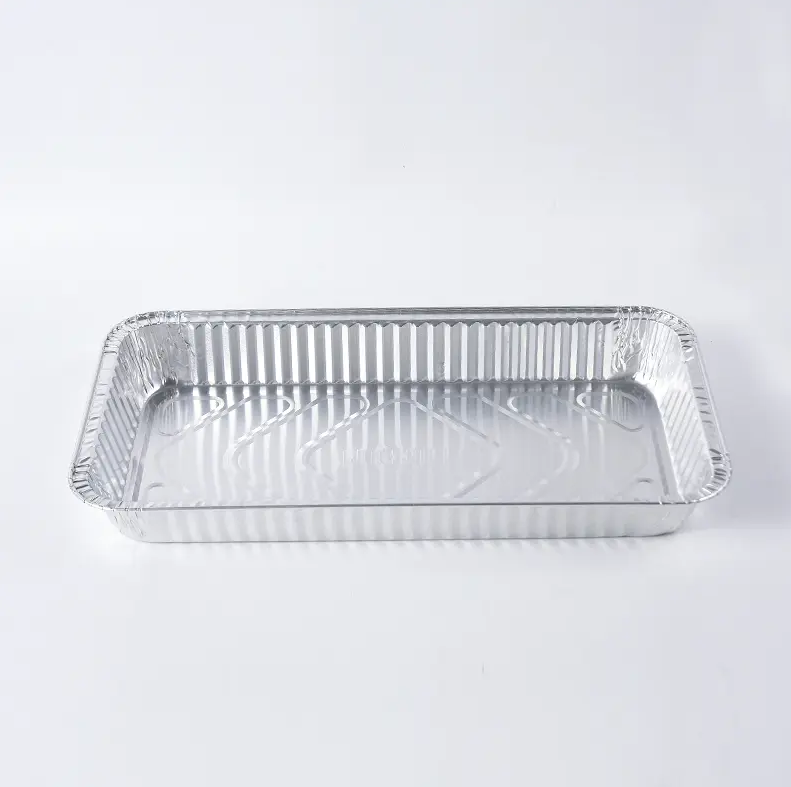
Matching Container Gauge to Cooking Temperature
Aluminum foil containers are manufactured in various gauges (thicknesses), typically ranging from 30 microns to 150 microns. Gauge selection is critical when high heat is involved.
| Gauge (Microns) | Recommended Use | Max Oven Temperature | Typical Application |
|---|---|---|---|
| 30–50 | Cold or room-temp food | Not recommended for oven use | Takeaway, cold salads, deli items |
| 60–80 | Light baking | Up to 180°C (356°F) | Muffins, small pastries, reheating |
| 90–120 | Standard baking and roasting | Up to 220°C (428°F) | Casseroles, roasted meats, lasagna |
| 130–150 | Heavy-duty professional use | Up to 250°C (482°F) | Whole poultry, commercial catering |
Using a thin-gauge container (under 50 microns) in a 200°C oven risks warping and potential spillage—a safety hazard beyond just ruined food.
Best Container Types for Specific Food Categories
Meat and Poultry
Large roasting pans with ribbed bottoms are the preferred choice for meats. The ribbed design elevates the food slightly, allowing fat to drain and preventing the base from becoming soggy. For a whole chicken (approximately 1.5–2 kg), a rectangular tray of at least 35 × 25 cm with 5 cm walls is recommended. Heavy-gauge containers (120+ microns) are essential to support weight without bending when lifted.
Seafood and Fish
Fish releases significant moisture during cooking. Oval containers or shallow rectangular trays with slightly raised edges (2–3 cm) prevent liquid from pooling under the fish while still capturing flavorful juices. For fish fillets weighing 200–300 g each, a container of approximately 20 × 14 cm per serving provides adequate space without crowding.
Baked Goods and Pastries
Baking demands precise dimensions. Thin-walled round containers work well for individual tarts and quiches. Muffin trays with 6 or 12 cups, each cup holding 80–100 ml, are the industry standard for cupcakes and muffins. Avoid overly thick-walled containers for delicate pastries, as excess aluminum mass can cause uneven browning on the sides before the center is fully set.
Liquid and High-Moisture Dishes
Soups, stews, curries, and braised dishes require deep containers with a minimum wall height of 5–7 cm and a smooth, sealed base without perforations. Containers with rolled or reinforced rims are strongly preferred, as the extra structural rigidity prevents the sides from collapsing under liquid weight. Look for containers explicitly labeled as "leak-resistant" or "deep dish."
Frozen and Ready Meals
When food will be frozen and reheated later, thermal shock resistance becomes a key factor. Multi-compartment trays (such as those commonly used in airline catering or meal prep services) allow multiple food items to be stored and reheated simultaneously without flavor transfer. These trays typically feature 2–4 compartments per tray with individual wall heights of 2–3 cm.
Lid Compatibility: Sealed vs. Open-Top Containers
Many aluminum foil containers are available with matching cardboard, plastic, or foil lids. The choice of lid type affects both food safety and presentation:
- Aluminum foil lids: Best for oven use, as they withstand high temperatures and can be crimped tightly to retain steam during cooking.
- Cardboard lids: Suitable for cold takeaway foods, offering a printable surface for branding and labeling. Not suitable for reheating.
- Clear plastic lids: Ideal for showcasing food appearance in retail settings, but limited to temperatures below 70°C (158°F).
For food safety in transit, always choose a lid that fits flush to the container rim. A lid that is even 1–2 mm too large can allow contamination and moisture loss during delivery.
Acidic and Salty Foods: A Special Consideration
Acidic foods—such as tomato-based sauces, citrus marinades, or vinegar-heavy dishes—can react with aluminum, particularly during prolonged storage. While the amounts involved are generally below health thresholds established by food safety authorities (the European Food Safety Authority sets an acceptable weekly intake of 1 mg aluminum per kg of body weight), there are practical reasons to minimize contact:
- Metallic taste can develop in acidic dishes stored for more than 2 hours in uncoated containers.
- Anodized or coated aluminum containers offer a protective layer that significantly reduces reactivity.
- For highly salty or acidic foods, lining the container with parchment paper before filling is a cost-effective mitigation strategy.
Portion Size and Volume: Choosing the Right Capacity
Container capacity directly affects portion control, cost efficiency, and customer satisfaction in food service settings. Below is a practical reference for common portion scenarios:
| Food Type | Serving Size | Recommended Container Volume | Suggested Dimensions |
|---|---|---|---|
| Rice or grain dishes | 1 person | 500–700 ml | 18 × 13 × 4 cm |
| Soup or curry | 1 person | 400–600 ml | Deep round, 14 cm diameter × 6 cm |
| Lasagna or casserole | 4–6 people | 3,000–4,000 ml | 32 × 26 × 6 cm |
| Individual pie or quiche | 1 person | 200–350 ml | Round, 12 cm diameter × 3 cm |
| Whole roast chicken | 3–4 people | N/A (by weight capacity) | 38 × 28 × 6 cm, 150-micron gauge |
Sustainability and Recyclability Considerations
Aluminum is one of the most recyclable packaging materials available—approximately 75% of all aluminum ever produced is still in use today, thanks to high recycling rates. When choosing foil containers, consider the following:
- Containers made from recycled aluminum content (typically 50–95%) require up to 95% less energy to produce than virgin aluminum.
- Thicker-gauge containers (80+ microns) are more likely to be recovered and recycled by consumers, as they are perceived as more durable and worth rinsing.
- Avoid containers with non-aluminum laminate coatings if recyclability is a priority, as mixed materials complicate processing.
For businesses seeking to reduce their environmental footprint, specifying containers with certified recycled content and encouraging customers to rinse and recycle is a measurable and achievable step.
Practical Tips for Buying in Bulk for Food Service
For catering businesses, restaurants, or meal prep operations purchasing aluminum foil containers at volume, keep these guidelines in mind:
- Standardize on 2–3 container sizes to reduce storage complexity and lower unit costs through higher-volume orders.
- Request sample batches before committing to large orders—fill containers with water to test for leaks and check lid fit precision.
- Ensure containers are certified food-safe (e.g., compliant with EU Regulation 10/2011 or FDA food contact standards) to avoid liability issues.
- Verify stackability: containers that nest securely reduce storage space by up to 60% compared to non-nestable designs.
- Consider custom printing on lids for brand visibility if containers are used for direct customer delivery.